Showing posts with label incense. Show all posts

20 February, 2021

Chakra 101: The Root Chakra


You will hear people referring to chakras in popular culture, in conversations, and in spiritual practice - but do you know what Chakras are and how to work with them? It all sounds like a bunch of jargon at times, I know. So, this is where I shall attempt to drift away from the proverbial mumbo jumbo, and explain it in as simple a way as possible. 


The Root Chakra


Sanskrit: Muladhara (मूलाधार, Mūlādhāra
Meaning: "root and basis of Existence."
Etymology:  Mula means root and adhara means basis.
Number: 1 of 7 Primary chakras.
Origins: Hindu tantrism. 
Symbol: A lotus flower with four red petals and a yellow square in the centre. On each petal, there sometimes are Sanskrit letters - va, scha, sha and sa. In the center, there would be the syllable lam - which is the Mantra of this Chakra. 
Colours: Red or Pink. 

Muladhara is located near the Tailbone beneath the sacrum - which is a large, triangular bone at the base of the spine that forms by the fusing of sacral vertebrae S1–S5.

The Root Chakra's kshetram, or superficial activation point, is located between the perineum and the tailbone/pelvic bone. 

Because of its location and connection with the act of pooping, it is associated with the butthole. 

It is also believed that Muladhara is a subtle abode of the Hindu God Ganapati.

The Root Chakra's Function

The Root Chakra keeps us grounded and roots us to familial beliefs that support the early formations of identity and a sense of belonging. It is all about family dynamics, and basic needs like feeling safe, supported, and provided for.

One might say that the Root Chakra is the centre for all of our primal needs. The main focus of this chakra is food, sex, shelter, and survival. Given that Humans are Pack Animals, this chakra also encompasses loyalty and honor to the “pack.”

The Muladhara is gorgeously primordial with earthly feminine power. It is the power of touch during love-making, or the loving affection in the form of hugs and kisses we give to our children.

The Root Chakra is the foundation of life and it urges us to procreate and express physical and supportive love to those we cherish.

How to Activate the Root Chakra
Activating and Healing the Root Chakra are two sides of the same coin. There are various ways to focus on your Root Chakra in order to heal it, balance it, and ultimately, activate it. 


If you're into Yoga, the Yoga Poses for the Root Chakra include the Warrior One, Triangle Pose, and Eagle Pose. 


The crystals portrayed above serve many purposes, but I figured I'd highlight their most relative properties within a Root Chakra workings context - 

Black Onyx - Grounding, Protection, Dispelling Negativity
Bloodstone  - Grounding, Motivation
Brecciated Jasper  - Creativity, Uplifting, Calming
Carnelian  - Drive, Determination, Organisation
Garnet - Passion, Creativity, Inner Strength
Golden Tiger's Eye - Courage, Determination, Relentlessness
Hematite - Grounding, Attract positivity, Stability
Kalahari Desert Jasper - Positivity, Joy, Grounding
Kyanite - Ancestral Healing, Self Acceptance, Grounding
Lava Stone - Renewal, Self growth, Positivity
Leopard skin Jasper  - Courage, Self Acceptance, Motivation
Mookaite Jasper - Self Realisation, Energising, Motivation
Red Jasper - Determination, Self Love, Centering
Red Tiger's Eye - Determination, Centering, Relentlessness
Rhodonite - Balance, Self Awareness, Growth
Smoky Quartz - Dispelling negativity, Clarity, Uplifting
Snowflake Obsidian - Grounding, Protection, Balance
Tourmaline - Grounding, Protection, Dispelling Negativity


Essential Oils are another good tool to use for Root Chakra work. All of the above oils are fit for purpose. I know that they all seem to be a big jumble, so I've created a handy guide for the oils, indicating both the Aroma family they belong to, as well as what Note they are. If you're confused by the mention of Aroma and Notes, check out the previous blog post where I explained these in quite a lot of detail. You can find it here.


Remember to always dilute an Essential Oil using a Carrier Oil if you intend to apply it topically.
 

If oils aren't your thing, Incense is a great alternative. Incense comes in a variety of formats. Resin incense is quite possibly my personal favourite when it comes to Chakra work.  It can be used in a couple of different ways - which I had covered in this previous post

 
If you're more of an Incense Stick kind of person, there is also a selection of such incense you might want to use when working on the Root Chakra, such as the below:


Else, if you're like me and are somewhat clumsy, which means you too have a few incense stick burn marks in your sleeves and/or on your arms, Incense Cones might be better suited - such as the below:


Oh, and if you're wondering what the Red tubes featured in both Incense Sticks and Incense Cones photos are - they are Strawberry Scented incense that come with their own little incense holder, on which the Root Chakra symbol is featured. Also - the reason I included Nag Champa is that, it is a Sandalwood based blend.


And on that note, it is time to bring this post to an end. If you're too antsy to wait for the next Chakra 101 post, and want to read more about the topic, I would highly recommend the Chakra Bible, as displayed above. It is a treasure trove of a book!


Until next time!


Ros

28 November, 2020

The Scents and Colours of Yuletide

The festive season is a time when many people enjoy staying indoors with their family, and as a consequence, the hearth takes the center stage. 


There are some specific scents that we all associate with the Winter Festive Season - and so today we will have a look at the variety of scents in stock at Fata Morgana which are especially wintery! 

The Three Magi

In the Christian narrative, Three Magi - also known as the Three Kings or Three Wise Men - called Melchior, Balthazar and Caspar travelled from the East, following a star to the birthplace of Jesus. They are said to have brought gifts to the Baby, namely Gold, Frankincense & Myrrh. 

 
Apart from their names, the three Magi developed distinct characteristics in Christian tradition, so that between them they represented the three ages of (adult) man, three geographical and cultural areas, and at times, other things. 

Their ages are often said to be 60, 40 and 20 respectively, and their geographical origins are variable.

Caspar:

In one tradition as reflected in art by the 14th century (such as in the Arena Chapel by Giotto in 1305), Caspar is old, normally with a white beard, and gives the gift of Gold.  He is "King of Tarsus, land of merchants" on the Mediterranean coast of modern Turkey, and is first in line to kneel to Christ. 

Melchior:

Melchior is middle-aged, giving Frankincense from Arabia.

Balthazar:

Balthazar is a young man, very often and increasingly black-skinned, giving the gift of Myrrh from Saba (modern south Yemen). 

He is often said to be hailing from Ethiopia or other parts of Africa, and this being represented accordingly.  Balthazar's blackness has been the subject of considerable recent scholarly attention; in art it is found mostly in northern Europe, beginning from the 12th century, and becoming very common in the north by the 15th.

The topic of who is whom, and who brought which gift at times varies depending on the tradition. The gift of gold is sometimes associated with Melchior as well and in some traditions, Melchior is the old man of the three Magi.


An alternative to Myrrh is Oppoponax, which is also referred to as Sweet Myrrh. 
Opopona Resin Incense - Stock Item
 
Opoponax is a glorious resin often used in performers. It is smokey, soft, luminous and sensual all at once. Some compare its smell to crushed ivy leaves, whereas others are reminded of angelica, frankincense and celery. 

Opoponax catches alight easily, so it is easy to understand why it has been used as incense for centuries. King Solomon is said to have regarded opopanax as ‘the noblest of incense gums’.

How does one use resin incense? 

The most popular method to use this type of incense is to burn it using a lit charcoal disc in a fireproof container. 

An alternative, which is smoke-free, is to diffuse it. 

What you'd need is:

- Oil Burner such as the one portrayed above (the deeper the bowl the better when it comes to resin) 
- Your resin incense of choice
- Tealight candle
- Thin, unscented vegetable oil such as sunflower or rapeseed oil. 
- Matches/lighter

1) Pour a small amount of vegetable oil into the dish. How much oil you use will depend on the size of the dish. Deeper bowls are ideal in this instance as there is less risk of spillage and can accommodate larger incense nuggets. 

You will want to add around 1 to 2 teaspoons of oil at the very least, but not more than half the depth of the dish.

2) Add a few nuggets of incense. Start small. You don't want to accidentally overdo it, and end up with too strong a smell. 

3) Light the tealight candle and position it inside the burner. Don't use votive candles, they're too tall for this purpose even though they fit. Also, don't use scented candles as they will interfere with the scent of the incense. 

4) As the oil warms up, the resin will start excluding its natural oils. Don't leave the burner unattended, and one you're done, blow out the candle. Replace the incense after 3 or 4 uses, and at this point you may wish to top up the oil. Allow the burner to completely cool down before the cleaning it. 

Speaking of Oil burners... 


Wax melts are highly sought after nowadays! 
Eco Soy Wax Melts - Stock Items - Priced at Eur6 each
 

All you need to use Wax Melts are:

- Wax burner
- Tea light candle
- Wax melts
- Lighter/matches

Light up the candle, place it in the cavity of your burner, and place a couple of wax pellets in the burner's bowl. That's it! 

And before we move on from Burners... 


Another option to scent your home is to use essential oils. 

Besides from Frankincense and Myrrh, there are many other wintery scents one could opt for. For ease of reference, I have grouped them based on their Aroma Family. All of the oils displayed below are stock items - I will link the most recent price list before we move on to the next topic.

In the Citrus Family, we find several essential oils that can be included in winter blends, or used by themselves. Citrusy smells are a mood lifter, and remind us of long, summer days. As the longest night of the year approaches, these scents give us renewed hope and remind us that after the dark, the sun shall indeed rise again. 

Resinous essential oils are possibly the smallest aroma family. Alongside Frankincense and Myrrh, we also find Benzoin that is often used in perfumery and in oil blends. Benzoin is a resin that has quite a lot of depth and facets. It has a recognisable vanilla-like sweetness and can sometimes smell a little smokey like whiskey. In essence, it is a wonderful scent. 

The Woody/Earthy scents above include 4 Coniferous trees, namely, Cedar, Pine, Spruce and Cypress, and 2 Dedicous trees - namely Sweet Birch and Sandalwood. The oils from these trees are grounding and perfect for recreating a magickal winter forest feel at home. 


 The Herbaceous scents above are all different - Bay leaf has a strong, camphorous, herbaceous, spicy scent. It is an evergreen tree and its oil adds a fresh scent that is somewhat eucalyptus-like. 

Sage is herbaceous, sweet and slightly camphorous. You will be familiar with its scent if you use Sage as a herb in cooking. true to the herb used in cooking and burning. It blends well with Spicy aromas, as well as with light floral aromas.

Marjoram belongs to the same family as Oregano, however it is far less pungent, and has a slightly camphorous, woody, herbal scent with a hint of spice.It blends really well with a lot of different essential oils, especially floral, herbaceous and spicy essential oils. 

Vetiver is closely related to other fragrant grasses such as lemongrass and citronella. It has a complex earthy, woody scent.The scent has often been compared to the sharp smell of uncut grass on a warm day. It blends especially well with floral, citrus and Woody/earthy aromas. 

Spicy oils bring a warmth with them that is much sought after during the colder months. You will recognise the above oils from your spice rack, and many of them feature in festive food recipes. 

Last but definitely not least, we have the Minty oils. Fresh and much sought after for their best known quality - that is, helping with respiratory problems that the colder months tend to bring with them. 

Essential oils can be used in many different ways. We have already mentioned Oil burners, such as the ones displayed above. 

When using the oils in an oil burner, you'll need:

- An oil burner
- A tealight candle
- Your preferred oils
- Water
- Lighter/matches

You'll need to put some water in the Burner's bowl, and add a few drops of your preferred essential oil(s). Light up the candle, and place it in the cavity of the oil burner. 

That's all there is to it! Just make sure you don't let the oil burner dry out as it can crack. 

Alternative ways of using Essential oils

One of the most popular ways of using Essential oils nowadays is by using an Aroma Diffuser. 

 
The diffuser contains a water tank, which needs to be filled up. Inside there is an indication of the maximum level of water it can take. You then add a few drops of your preferred essential oil(s), and you switch it on. 

That's all there is to it! Once it is empty it will automatically switch off. 

The good thing about this electrical diffuser is that it changes 7 LED light colours as it works, so it makes for a visually pleasing trinket to have around. 

Topical Use is another option. When applying essential oils to the skin, they need to be diluted with a carrier oil. 
 
Roller top bottles are the ideal gadget to use in this instance. You can use either 1 essential oil, or create your own blend, and then top it up with your preferred carrier oil. Not only are these Roller Top Bottles handy and mess free to use, but they also help prolong the lifetime of your Essential oil Blend since they're made from amber glass. 

To view the latest version of the Essential Oil & Carrier oils list, please see 

https://drive.google.com/file/d/1pvT-HlQWhyGLBw0wfdtJpycZj28G-uS8/view?usp=sharing


Last but not least - Soaps! 

 
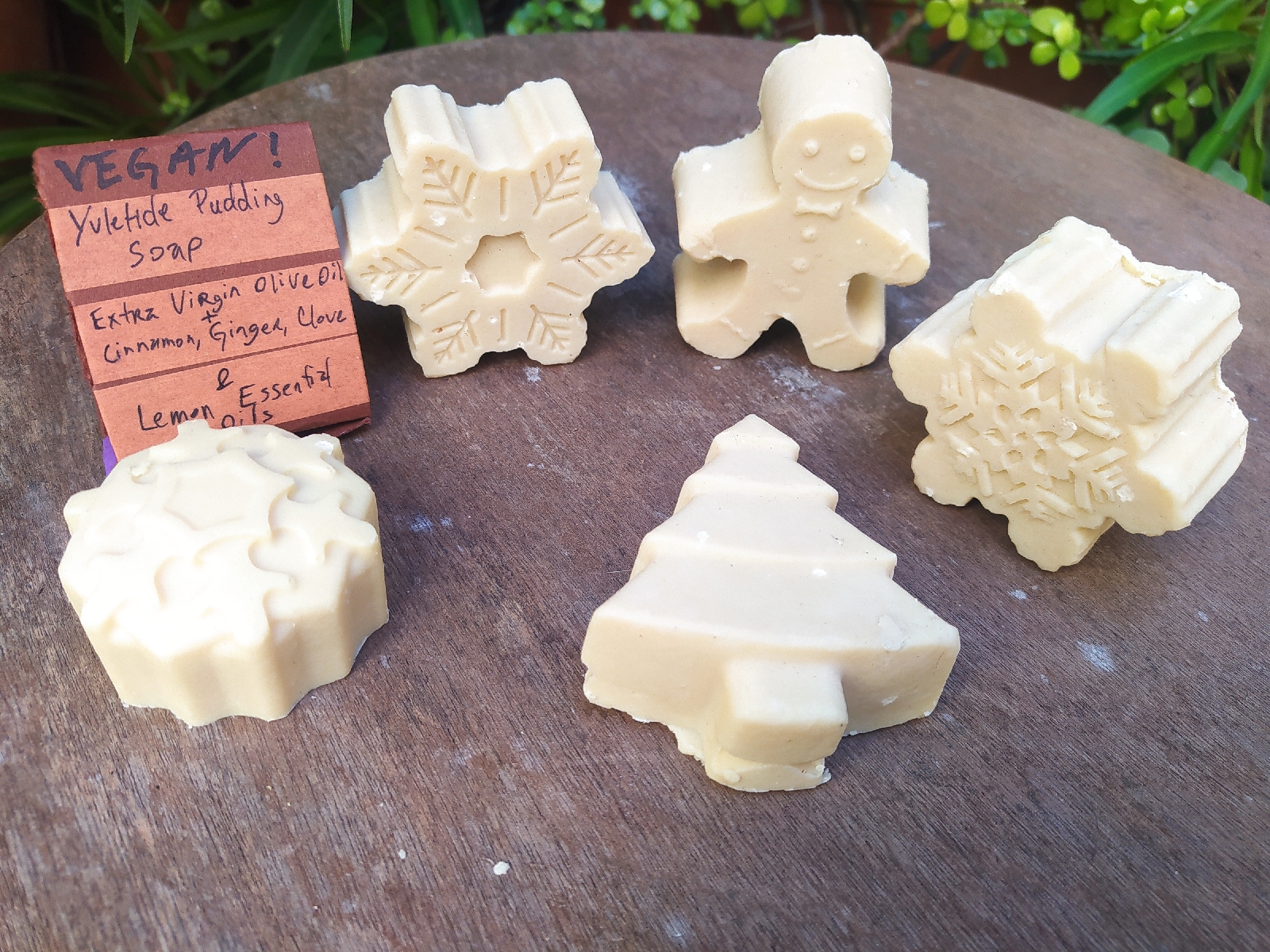
We make Seasonal Vegan soaps - and by we, I mean my partner and myself. These soaps contain a blend of Cinnamon, Ginger, Clove & Lemon essential oils, and they smell like a delicious desert! In fact, after finishing making these soaps, we had to run back inside and eat as the scent actually caused hunger pangs. True story! 

We spoke of unscented candles, but what about scented ones? 

During this time of the year, scented candles are another popular option. 

 
Some candles are scented with a mix reminiscent of festive drinks, such as the one above. 

 
Others are scented with blends reminiscent of foods such as Cinnamon and Spiced Apples or Pears and Spiced Cider such as the candle displayed above. 

Winter wonderland Scented Candles - Stock items

Others still are blends that are wintery such as the three candles above. 

Winter Forest has a sweet, woodsy scent and is subtely floral. 
Angel Wings has a minty yet sweet scent. 
Pinecone is, as one might expect, pine scented, but slightly sweet. 

 
Then we have themed candle holders - such as these tealight holders which come with Berry scented tealight. 

Bringing us full circle, we'll touch on different types of incense. 


Incense sticks are possibly the first type of incense that people think of when thinking of incense. 

The fun thing about this type of incense is that one can find many different types of incense holders - including seasonal ones such as the Angel ones above, or the snowflake ones below:


My personal favourite when it comes to ready made incense though are Incense Cones!

Same as the incense sticks, there are many different burners that can be used for incense cones - some will have a chimney effect such as the two displayed below:
 
Others will have the cone in full display, but will be themed, such as the ones below:
 

And colours? 


You might have noticed a pattern emerging already - Gold, Silver, Green, Red and White are by far deemed to be the official colours of the Festive season. This is apparent just by looking at the colour schemes in the photos above. 


In conclusion


I think I've rambled on for long enough. So, I will leave you on this note. 

This year we have been dealing with a worldwide pandemic. Get creative in the ways you celebrate with extended family and with friends - the internet is full of free tools which can be used to bring people together virtually. Just because you cannot be in physical proximity doesn't mean you can't spend time with your loved ones. 

Until next time! 


Ros

09 October, 2020

Samhain Incense Blend


I have decided to create a unique Incense blend for Samhain this year. With resin incense becoming increasingly popular, it felt like the right time to take the plunge into making this. 

I have made a limited quantity of this blend, and it is available for purchase at the price of €6 per glass jar. You can do so by getting in touch via Facebook or Instagram

How to use the Samhain Incense Blend:


You will need:
  • Fireproof container - a censer, or a cauldron will do just fine. 
  • Charcoal disc 
  • Tongs - if you have fancy charcoal tongs, all the better, if not then kitchen tongs will work just as well. 
  • Lighter or matches
  • Samhain Incense Blend

When working with loose incense, make sure you have adequate ventilation in the room you will be using. 

Many people like to put a layer of sand at the bottom of their cauldron/censer/fireproof container of choice for extra insulation. Be careful when you handle your fireproof container as heat travels and it can still be surprisingly warm to the touch. 

Packet of 10 Charcoal Discs - Stock Item

Light up your charcoal disc, holding it with your tongs. Once you're happy it has lit up, place it in the middle of your fireproof container - I shall refer to it as a cauldron, since that's what I prefer to use. 

Place a pinch of the Samhain Incense Blend on top of the charcoal disc. A little goes a long way. It is always better to put the incense on a little at a time, topping it up whenever you wish. That way you won't be wasting any, and it won't be overpowering. 


About the blend:

When working with loose incense, one can find many recipes out there, however it often happens that they are created with the intent in mind rather than the scent.

I am happy to say that this blend has a pleasant scent! I asked a dear friend, who is brutally honest and who is well versed in the usage of loose incense, to provide me with feedback. I was looking for 3 boxes to be ticked - how well it burns, how well it smokes and what it smells like. 

The feedback received was that it burns nicely, it smokes well, and it has a pleasant, long lasting smell when it is burning.

It is a given that I was also interested in knowing how well it fares ceremoniously - and the feedback in that aspect was that it worked very well. The lingering scent after the rite was complete - and I quote verbatim - helped bring up subtler sensations and connection to the work done. 

What's in it? 

This blend contains several ingredients, which I will break down below. The vast majority of the ingredients have been locally sourced in a sustainable manner - for example, the Cypress has been gathered from my favourite cemetery here in Malta whereas the Olive leaves have been harvested from our own Olive Tree. 


There’s rosemary, that’s for remembrance; pray, love, remember.

- William Shakespeare, Hamlet


Rosemary is a herb that has long been associated with remembrance and death. In ancient Roman times, the herb was used in burial rites for this reason. There are also several accounts of funerals in England where mourners traditionally tossed bouquets of rosemary on top of coffins.

Come away, come away, Death,

And in sad cypress let me be laid

- William Shakespeare, Twelfth Night


The cypress is a symbol of mourning, spanning from classical antiquity to modern day times. It remains the principal cemetery tree in both the Muslim world and Europe. 

In the classical tradition, the cypress was associated with death and the underworld, as it does not regenerate when cut back too severely. Athenian households in mourning were garlanded with boughs of cypress, and Cypress was used to fumigate the air during cremations. It was among the plants that were suitable for making wreaths to adorn statues of Pluto, the ruler of the Underworld. 

In Greek mythology, besides Cyparissus who was turned into a Cypress tree to be able to forever mourn the death of his favourite stag, the Cypress tree is also associated with the Goddesses Artemis (Goddess of the Moon and the Hunt, twin of Apollo), and Hecate (Goddess of magic, crossroads and the underworld) . 

While Wormwood hath seed get a handful or twaine

To save against March, to make flea to refraine:

Where chamber is sweeped and Wormwood is strowne,

What saver is better (if physick be true)

For places infected than Wormwood and Rue?

It is a comfort for hart and the braine

And therefore to have it it is not in vaine.’

- Tusser, 1577

Dried mugwort added to a fire will help keep it smoldering for a long time. In ritual, Mugwort is used for strength, psychic work, protection, prophetic dreams, healing, and astral projection.

The protective properties of Mugwort have been recorded since the European Middle Ages. It has also been used since ancient times as a remedy against fatigue and to protect travelers against evil spirits and wild animals. Roman soldiers put mugwort in their sandals to protect their feet against fatigue.

It was one of the nine sacred herbs given to the world by Odin. In Pre-Columbian times the Aztecs used mugwort as a ritual incense. 

Mugwort, whose latin name is Artemisia Vulgaris, is dedicated to the Goddesses Artemis and Diana

"At dawn one/we will see the form of the opoponax sitting on a windowsill." 

- Monique Wittig, translated by Helen Weaver, L'Opoponax. 


Opoponax is a resin from the plant of the same name which enjoys a warmer climate and grows in Iran, Italy, Greece and Turkey. The resin can be called "sweet myrrh" and King Solomon is said to be the Myrrh variant referred to in the Song of Solomon, as being the noblest of resins.

Opoponax is sometimes referred to as Sweet Myrrh, and when included in a blend, it helps the scent longer for a longer period of time. 

Opoponax helps relax the mind, ease stress and anxiety, and is particularly helpful in meditation. 

"Under a juniper-tree the bones sang, scattered and shining.

We are glad to be scattered, we did little good to each other.

Under a tree in the cool of the day, with the blessing of sand.

Forgetting themselves and each other, united

in the quiet of the desert."

- Ash Wednesday, T. S. Eliot


Juniper is traditionally used in Scottish folkloric and Gaelic Polytheist saining rites, where the smoke of burning juniper is used to cleanse, bless, and protect the household and its inhabitants.

Juniper was a symbol of the Canaanites’ fertility Goddess Ashera or Astarte in Syria. Although burning Juniper gives off only minimal visible smoke, this smoke is highly aromatic, and in ancient times it was used for the ritual purification of temples. The smoke is said to aid clairvoyance, and continued to be burned for purification and to stimulate contact with the Otherworld at the autumn Samhain fire festival at the beginning of the Celtic year.


"In the olive grove, a wise man at the feet and a wild man at the head."

- Traditional Sicilian proverb


Olive is the traditional plant used in Malta to protection against the evil eye. Eirene, Goddess of Peace, was depictes holding an olive leaf in her hand. In the Bible, an olive branch is also a symbol of hope and Peace. 

It has therefore been included in this blend as a plant to allow peaceful transition between the world of the living and that of the dead. 

Why should a man die when sage grows in the garden?”

- English proverb


The Romans regarded sage quite highly and much sacrifice and ceremony was associated with its harvest. They believed it stimulated the brain and memory. 

The White sage included in this blend is coated in Dragon's blood resin. 

Dragon's Blood is great for protection work, and boosts the properties of all other ingredients in a loose incense blend. It is particularly a useful resin to use when emotional strength is needed, and it is also often used to honour deities and the Ancestors. 

This is a time of the year to honour and to remember our loved ones who have died. It is said that the veil between the world of the living and that of the dead is at its thinnest on Samhain - that's the 31st of October. Having said that, the transition is gradual, and the entire month of October is a good time for psychopomp workings. 

May your reunion with those who have passed on be joyous and fruitful, and may it bring closure. 

Until next time!


Ros


22 August, 2020

Natural Insect Repellent 101

I often get asked for recommendations of what to use to keep mosquitoes away - especially in the warmer Summer months, where the days are long and warm, which make people want to be out and about even more than usual.


There are several natural scents that keep Mosquitoes away - and not just the mozzies! I've put together a simple Venn diagram showing what scents are useful as insect repellent for the main 3 insects we deal with in Malta - Mosquitoes, Fleas and Ticks.


Peppermint

Aroma family: Minty

Note: Top

Blends best with: Other Minty aromas, as well as  Citrusy, Camphoraceous, Herbaceous, and Woody/Earthy oils.

Lemon

Aroma family: Citrusy

Note: Top

Blends best with: Other Citrusy aromas, as well as Woody/Earthy, Floral, Camphoraceous, and Spicy oils.

Basil

Aroma family:  Herbaceous

Note: Top to Middle

Blends best with: Other Herbaceous aromas, Camphoraceous , Floral, and Woody/Earthy oils.

Clove

Aroma family: Spicy

Note: Base

Blends best with: Other Spicy aromas, Citrusy, Woody/Earthy, and Floral oils.

Geranium

Aroma family: Floral

Note: Middle

Blends best with: Other Floral aromas, Woody/Earthy, Spicy, and Citrusy oils.

Citronella

Aroma family: Citrusy

Note: Top

Blends best with: Other Citrusy aromas, Floral, Herbaceous, and Woody/Earthy oils.

Eucalyptus

Aroma family: Minty/Camphoraceous 

Note: Top

Blends best with: Other Minty & Camphoraceous aromas, as well as Floral, Herbaceous, Woody/Earthy, and Spicy oils.

Lavender

Aroma family: Floral

Note: Middle to Top

Blends best with:  Other Floral aromas, Resinous, Woody/Earthy, Spicy, and Citrusy oils.

Lemongrass

Aroma family: Citrusy

Note: Top to Middle

Blends best with: Other Citrusy aromas, Woody/Earthy, Camphoraceous, Spicy, and Floral oils.

Thyme

Aroma family: Herbaceous 

Note: Top to Middle

Blends best with: Other Herbaceous aromas, Camphoraceous, Floral, and Woody/Earthy oils.

Oregano

Aroma family: Herbaceous/ Spicy

Note:  Middle

Blends best with: Other Herbaceous aromas, Camphoraceous, Floral, and Woody/Earthy oils.

Rose Geranium

Aroma family: Floral

Note: Middle

Blends best with: Other Floral aromas, Resinous, Woody/Earthy, Spicy, and Citrusy oils.

Juniper

Aroma family: Woody/Earthy

Note: Middle

Blends best with: Other Woody/Earthy aromas, as well as Spicy, Floral, Citrusy, Camphoraceous, and Herbaceous oils.

Rosewood

Aroma family: Floral/Spicy

Note: Middle

Blends best with: Other Floral and Spicy aromas, as well as Resinous, Citrusy, and Herbaceous oils.

Grapefruit

Aroma family: Citrusy

Note: Top

Blends best with: Other Citrusy aromas, Woody/Earthy, Camphoraceous, Spicy, and Floral oils.

Cedarwood

Aroma family: Woody/Earthy

Note: Base

Blends best with: Other Woody/Earthy aromas, as well as Spicy, Floral, Citrusy, Camphoraceous, and Herbaceous oils.

Tea Tree

Aroma family: Minty/Camphoraceous

Note: Middle

Blends best with: Other Minty/Camphoraceous aromas, as well as Citrusy, Woody/Earthy, and Floral oils.

Orange

Aroma family: Citrusy

Note: Top

Blends best with: Other Citrusy aromas, Woody/Earthy, Camphoraceous, Minty, Spicy, and Floral oils.

Scots Pine

Aroma family: Woody/Earthy

Note: Top

Blends best with: Other Woody/Earthy aromas, as well as Spicy, Floral, Citrusy, Camphoraceous, and Herbaceous oils.

Patchouli

Aroma family: Spicy/Woody/Earthy

Note: Base

Blends best with:Other Spicy and Woody/Earthy aromas, as well as , Floral, Citrusy, Resinous, and Herbaceous oils.

Neem

Neem oil has a strong garlic/nutty aroma – unpleasant to some but loved by others.  A note of caution - Neem oil is not to be used by pregnant people. If you're in doubt or have underlying conditions, do your research first.


This is a guide for use by your average, healthy human being.

What if I don't like essential oils?

Have you ever noticed, whilst sitting around a fire, that you get bitten less? No? Well, mosquitos tend not to like smoke. Few people can realistically light up a fire on a daily basis - so a practical alternative would be incense.

Whilst all forms of incense will help due to the smoke they produce, if we go for the plants we covered above, that would be hitting two proverbial birds with one stone. We do, in fact, carry a variety of incense - in 4 forms: Incense Sticks, Incense Cones, Resin Incense & Backflow Incense Cones.

Ganesha Backflow Incense Burner - Stock Item

 Backflow incense is best used indoors to get the cascading smoke effect that is reminiscent of a waterfall seen from a distance. The effect is created thanks to a funnel like function and is truly mesmerising to watch. For the purpose of this post, I'd like to highlight the Lavender scented backflow incense cones. 

 If you like to use Incense cones outdoors, the regular cones would be better suited. Below is a selection of Incense Cones that are fit for the purpose of this post. The 4 in a cylindrical packaging come with a chakra inspired wooden holder, whereas the 3 at the front have a little tin disc included which can be used as a cheap and cheerful holder.


Finally, for those who like good old Incense Sticks, the Insect Repellent scents in stock as of Mid-August 2020 are the below - The vertical cylinder packaging ones also include a Chakra inspired Incense Stick Holder.

 
And so, as the sun sets on another day, and the mosquitoes make their presence felt once more, I'll bid you a good rest-of-your-day.
 

Until next time!

Ros

Essential Oil Spotlight: Bergamot

Bergamot Latin name: Citrus Bergamia Origin: Ivory Coast From: Fruit Peel Process: Cold Expression Consistency: Thin Perfumery Note: Top ...